We know that joining is a critical phase in the sheep production calendar. It’s essential to have a plan and use an array of tools to set your flock up for successful joining outcomes. Here, I’ve broken the plan down into four components: review, assess, allocate and monitor (RAAM). This article is not an exhaustive guide to joining; instead, it focuses on a few key aspects that will help you achieve success at joining.
Review
- Time of joining
- Length of joining
Time of joining
When was the last time that you reviewed your time and length of joining? Sometimes it can be easy to chuck the rams out before you get stuck into harvest or go on summer holidays. However, the time and length of joining are important decisions that have various flow-on effects that affect productivity, profitability, ease of management and the ability to meet market specifications. They also impact the timing of most other key events in the management calendar (pregnancy scanning, lambing, lamb marking and weaning), so they’re worth giving plenty of consideration.
Some of you will have already joined your flock for their next cycle or will be about to put the rams out. If this is you, then I appreciate that these decisions can’t be changed right now, but give them some thought before your next joining.
A great place to start when reflecting on the best time of joining/lambing for your enterprise is to review your pasture growth rates and pasture growth curve. Remember that, typically, the goal is to aim for lambing to start about a month before peak pasture production, so that the early lactation period, when the ewe’s energy demands peak, lines up with peak energy supply from pasture. Pasture is cheap, so make sure to make the most of it to avoid supplementary feed costs stacking up.
Another consideration is the seasonal nature of cycling in sheep. There are peak periods of cycling activity in ewes (more so for British breeds than Merinos). If there’s an incentive for you to join early (i.e. between September and December in the southern hemisphere), whether that be to align with your target market or for management reasons, then teasing is a useful tool to stimulate ewes to cycle and generate a more compact lambing.
Also, think about when you shear your ewes and rams. Shearing, along with other stressors, can disrupt the cycling activity of ewes for two weeks. Ensure your ewes are shorn and that any other necessary handling occurs well ahead of joining. Rams should be shorn eight to twelve weeks before joining to avoid sunburn, cuts, infection and susceptibility to heat stress at joining. Sperm production takes six to eight weeks in rams, so it’s important to avoid any stressors in the 8+ weeks before joining to make sure that the rams are in their prime when they go out with the ewes.
Length of joining
The Charles R. Swindoll quote, ‘The difference between something good and something great is attention to detail,’ rings true when it comes to joining length. There’s no doubt that many producers who join for longer periods can still do a good job with their ewes and lambs. However, with shorter joining periods, you have a much greater ability to pay attention to detail and implement precise management strategies to really ramp up performance.
If you currently leave your rams in with the ewes for longer than five weeks, a shorter joining period is something to consider. A more compact joining period can offer many benefits, with flow-on effects for the whole production cycle, even through into the following season:
- More precise and easy management - Most ewes will conceive within five weeks. The extra 2-4% lambs conceived during a longer joining complicate management due to delays in marking and weaning.
- Reduce the ‘tail’ - Shorter joining periods reduce the variation in both lamb age and weight at weaning and hence reduce the size of a tail-end in the mob.
- Worm management - Delaying weaning for later lambs can increase worm burdens and cause ewes and lambs to lose weight.
- Weaner survival - For later lambing flocks, later lambs are lighter heading into summer and tend to have poorer survival.
- Ewe recovery - Longer joining periods (and delayed weaning) mean that ewes have less time to recover before their next joining, which may compromise their reproductive performance next year.
Assess
- Ewe nutrition, liveweight and condition score
- Ram nutrition and condition score
- Health status and physical soundness of ewes and rams
Ewe nutrition, liveweight and condition score
Ewe nutrition is the key determinant of joining outcomes. This means it’s time to get weighing and/or condition scoring. Hopefully you’ve already done so, at least at weaning, and are managing ewes in poorer condition preferentially. Take care to avoid severe stress when joining ewes (e.g. a loss of more than 1kg of liveweight per week or extreme variation in feed quality), as embryo loss may be higher.
What are the key liveweight and condition score targets for ewes at joining?
- Ewe lambs should be at least 40-45kg at joining for optimal performance. Joining ewe lambs is something that requires plenty of attention to detail, so make sure you’re invested in doing it well if you’re taking the plunge for the first time (make that every time!). Check out the decision-support tool and Emma’s article (linked at the end of the article) for strategies on getting the most out of joining ewe lambs.
- Generally, maiden ewes should be 75-80% of their standard reference weight for a successful joining.
- Condition score (CS) targets for mature ewes differ slightly depending on breed:
- For merinos:
- Aim for CS 3+ at joining.
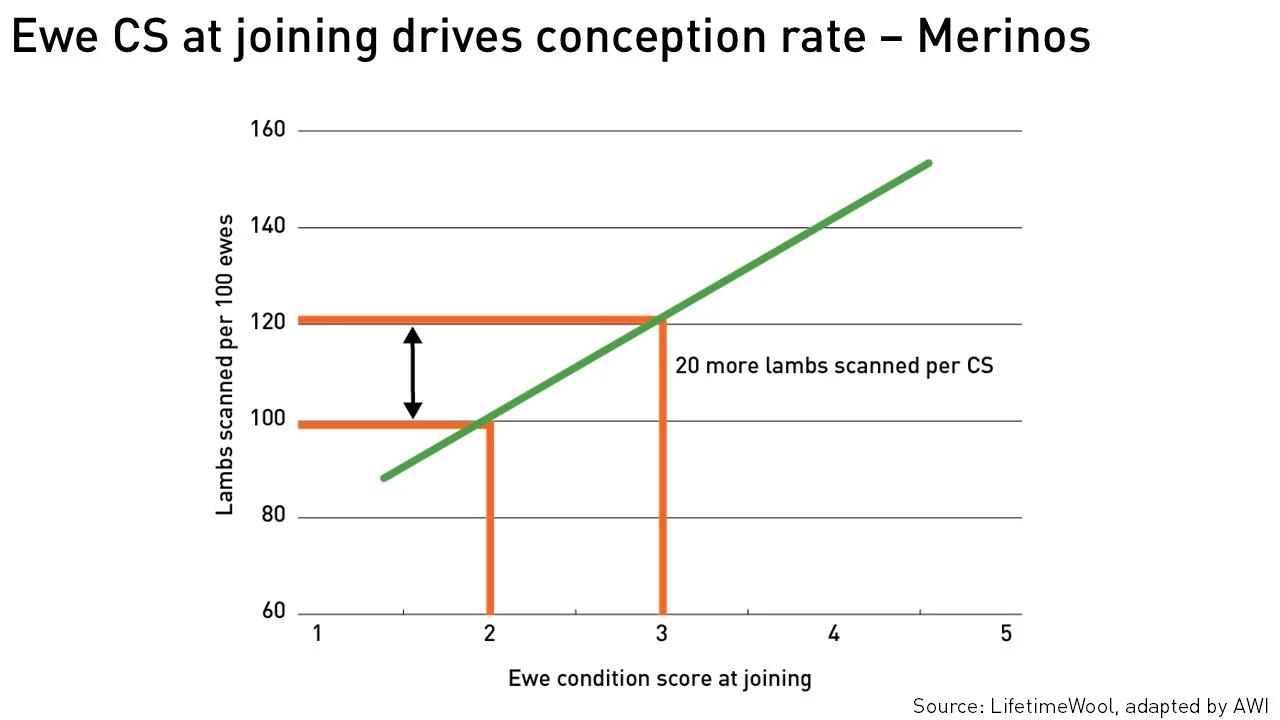
- The reproductive rate response in merinos is linear between ewes in CS 1.5 to 4.5 (i.e. the number of lambs conceived increases with increases in body condition); however, the risk of dystocia increases at scores of 4 or greater (LifetimeWool).
- On average, merino ewes conceive 20% more lambs for each additional CS at joining. This response varies from 7% to 36%, depending on genetics and the time of lambing, with later lambing likely to be more responsive (LifetimeWool; Figure 1).
- For maternals:
- Generally, the optimum CS at joining is 3.8 to 4.2.
- For flocks lambing earlier, the optimum CS at joining is the CS volunteered by the ewes without supplementary feeding, but the peak CS needs to be managed so that the target CS at lambing (about CS 3 for single-bearing ewes and CS 3.3 to 3.7 for multiple-bearing ewes) can be achieved without excessive weight loss during pregnancy (Blumer et al 2019).
- For merinos:
Ram nutrition and condition score
Ram nutrition and condition are also critical for reproductive success. Here are a few key points:
- Target CS 3.5 at the beginning of joining.
- Sperm production can be increased by feeding a high-protein supplement in the eight weeks before joining (e.g. 750g/hd/day of lupins).
- If your ewes are being supplementary fed during joining, ensure that the rams are accustomed to the same supplementary feed before they are put in with the ewes to avoid rumen acidosis.
Health status and physical soundness of ewes and rams
Both ewes and rams need to be healthy and sound heading into joining. This means:
- Checking that ewes and rams are free from worms, flies, lice and feet issues, and vaccinations are up-to-date.
- Examining rams for soundness at least eight weeks before joining, including checking the five Ts:
- Teeth: They’re going to be burning some energy, so make sure they’ve got sufficient teeth to keep up their feed intake.
- Toes: The rams have got plenty of work to do, so we don’t want any lameness or injuries to their feet and legs.
- Torso: Have you hit your target of CS 3?
- Tossle and testes: Make sure everything is intact with no lumps or bumps.
From my observations, checking rams well ahead of joining can get overlooked, with these checks quite often left to the day the rams are going out (if done at all). By this point, there is nothing you can do to rectify any issues or source replacements, unless you delay joining. So, make sure to invest the time and effort in checking your ram team well in advance of joining. Allow yourself plenty of time to make sure your rams are ready to roll come the start of joining.
Allocate
- Ram-to-ewe ratios
- Ram team audit
- Choosing your joining paddocks
Ram-to-ewe ratios
For all the ins and outs of managing rams for optimal joining performance, I would recommend reading Sophie Barnes’ article ‘Optimising ram performance’ (link below). I have included her handy guide to ram-to-ewe ratios across different classes of ewes (Table 1).
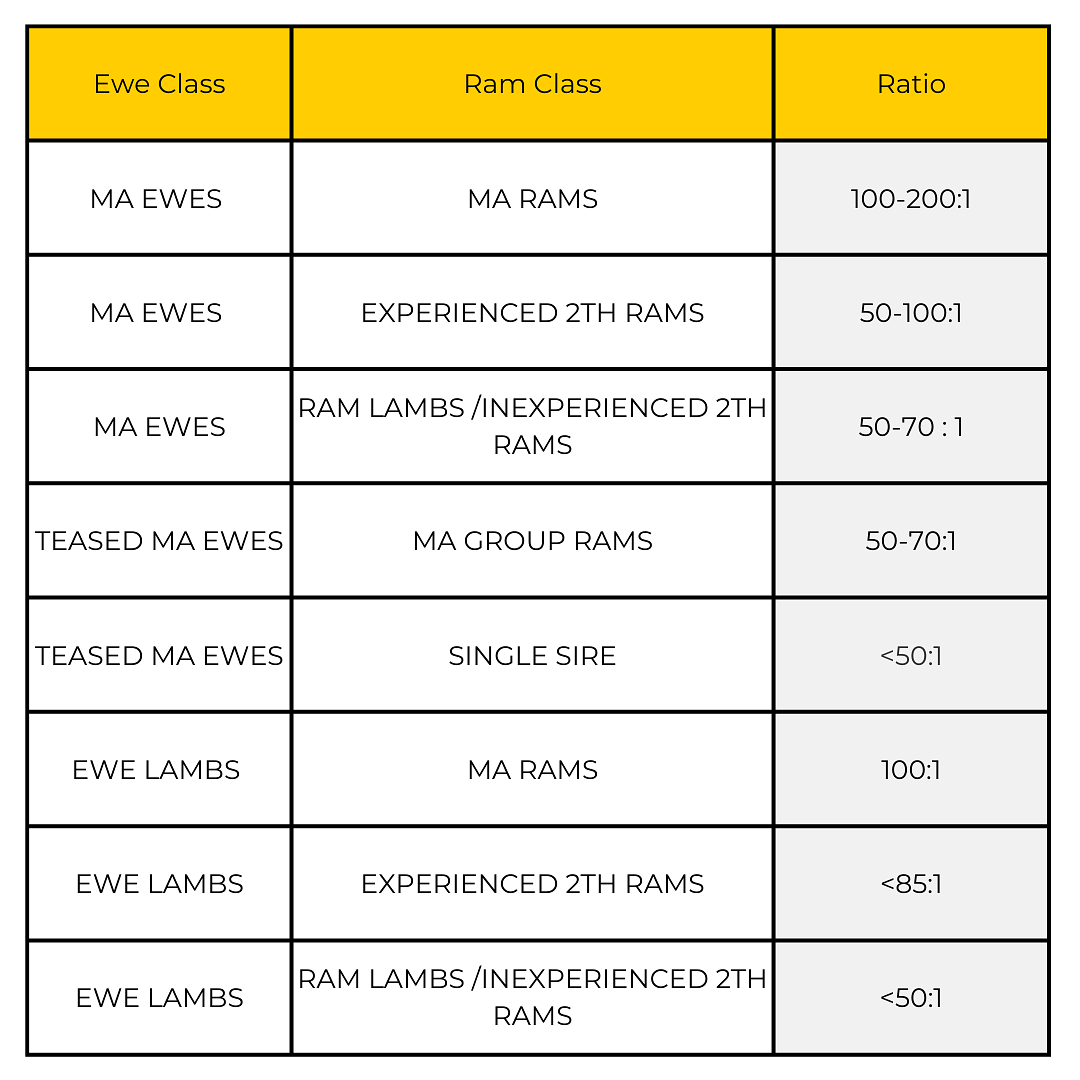
If you are joining in large paddocks with multiple watering points, or you are joining outside of the main breeding season, consider increasing ram percentages. And keep in mind that maiden and adult ewes are best joined separately, as they have different ram requirements.
Ram team audit
Returning to the matter of timing, it’s important to complete your ram team audit (and confirm that the number of rams in your ram team meets your requirements) well ahead of joining.
Ram-purchasing decisions shouldn’t be made ad hoc. Firstly, the genetics of your ram team will have an impact on your flock for several years, so your purchases deserve careful consideration. Secondly, any ram replacements purchased will need time to settle in ahead of joining (allow eight weeks for rams to acclimatise if they have been brought from outside your district). My advice is to make wise ram selection and purchasing decisions, informed by your breeding objective, visual assessment and the rams’ breeding values.
Choosing your joining paddocks
A final note on allocation. When selecting joining paddocks, take care to avoid pastures that may be toxic to sheep, and ensure sheep have access to plenty of good-quality water.
Monitor
It’s easy to slip into a ‘set-and-forget’ mindset once you’ve put the rams out (and again when you’ve removed them at the end of joining). But this is just the start of the reproductive cycle. Make sure you keep your eye on the ball!
A few key things to monitor:
- Ewe CS: Put a hand on at least 50 ewes per mob each time they’re in the yards, particularly at key times of the reproductive cycle (i.e. joining, pregnancy scanning, pre-lambing and weaning). Condition scoring is an often-overlooked tool that is vital for managing your flock well.
- Feed: Regularly assess the availability and quality of feed in paddocks, and update your feed budgets accordingly. Also, test your supplementary feed to calculate feed budgets accurately.
- Supplementation: Consider the need for any vitamin or mineral supplementation. In my previous article about sheep nutrition during late summer and autumn, check out the common things to watch for (link below).
- Water: Keep an eye on water quality (salinity, algae, etc.), especially in dry years.
And, lastly, don’t forget to book in your pregnancy scanner as soon as the rams come out!
—
In short
What you need to know about getting the most from your rams and ewes to optimise joining:
- Review joining length: Moving towards a compact five-week joining period improves management precision, reduces the ‘tail’ of the mob, assists worm control and aids ewe recovery.
- Assess ewe condition score (CS): Nutrition drives reproductive success; aim for CS 3+ for Merino ewes and CS 3.8–4.2 for maternals to maximise conception rates.
- Conduct ram health checks: Assess rams eight weeks prior to joining using the ‘5 Ts’ method (Teeth, Toes, Torso, Tossle and Testes) and target CS 3.5.
- Align lambing with pasture curves: Review your time of joining to ensure the ewe's peak energy demand (early lactation) coincides with peak pasture supply to reduce supplementary feed costs.
- Continue to monitor: Do not ‘set-and-forget’! Instead, regularly assess condition score, feed budgets, supplementation and water quality.
—
Further reading
- Making More From Sheep (website)
- Lifetime Wool (website)
- Department of Primary Industry and Regional Development’s Lambing Planner, available at: https://www.agric.wa.gov.au/management-reproduction/lambing-planner
- Blumer S, Behrendt R, Hocking-Edwards J, Young Y and Thompson A. “Final report: Lifetime maternals – Phase II: Feeding standards for maternal Ewes”. (2019) Meat and Livestock Australia Ltd, North Sydney NSW. Available at: l.lsm.0008_final_report.pdfhttps://www.mla.com.au/contentassets/d682b513baaf4b6e8e6ade8410035c57/l.lsm.0008_final_report.pdf
- Decision-support tool for joining ewe lambs
—
You might also be interested in …
- Mating ewe lambs by Emma Pettigrew (article)
- Optimising ram performance by Sophie Barnes (article)
- Sheep nutrition over late summer and autumn by Amy Lockwood (article)
- Sheep nutrition over summer and autumn with Amy Lockwood, Darren Gordon, Andrew Thompson and Mark Ferguson (webinar recording)
- Like a broken record: why I keep banging on about condition scoring by Mark Ferguson (article + neXtgen Agri BCS guide + BCS video)
—
Join the conversation on The Hub
Share your thoughts on getting the most from rams and ewes at joining over on the neXtgen Agri Hub.


.webp)