We all know the importance of scoring body condition on commercial farms to manage livestock at the individual level, helping to maximise productivity and profit. Body condition score (BCS) is one of the easiest, cheapest traits to measure on-farm. We know from the literature (and nearly every industry workshop) that ensuring your ewes are in optimum condition will have positive reproductive outcomes.
What shocked me was when I became aware of the number of stud flocks not actively recording BCS in their ewes. For a little bit of context, I am writing this with the SIL New Zealand percentile bands tables in front of me. For those of you who are doing it, well done, keep up the good work! For the rest of you, I want to dig into why recording this trait is so important.
Recording and benchmarking traits (including body condition score)
Firstly, some quick stats from the nProve breeder website (Table 1). I searched for maternal sheep, and then downloaded all of the breeders. For each trait, nProve notes either: ‘Recording and benchmarked’ (i.e. connected and comparable), ‘Recording’ (i.e. valid within flock, but not connected/comparable across flock) or ‘Not recording’. These figures were extracted in December 2025, with 303 maternal flocks in the analysis. In the terminal flocks, there were seven flocks that were recording and benchmarked, 21 recording, and 206 not recording BCS.
Table 1. Traits reported on nProve, including body condition score (BCS), showing the recording and benchmarking status of 303 maternal flocks in New Zealand.
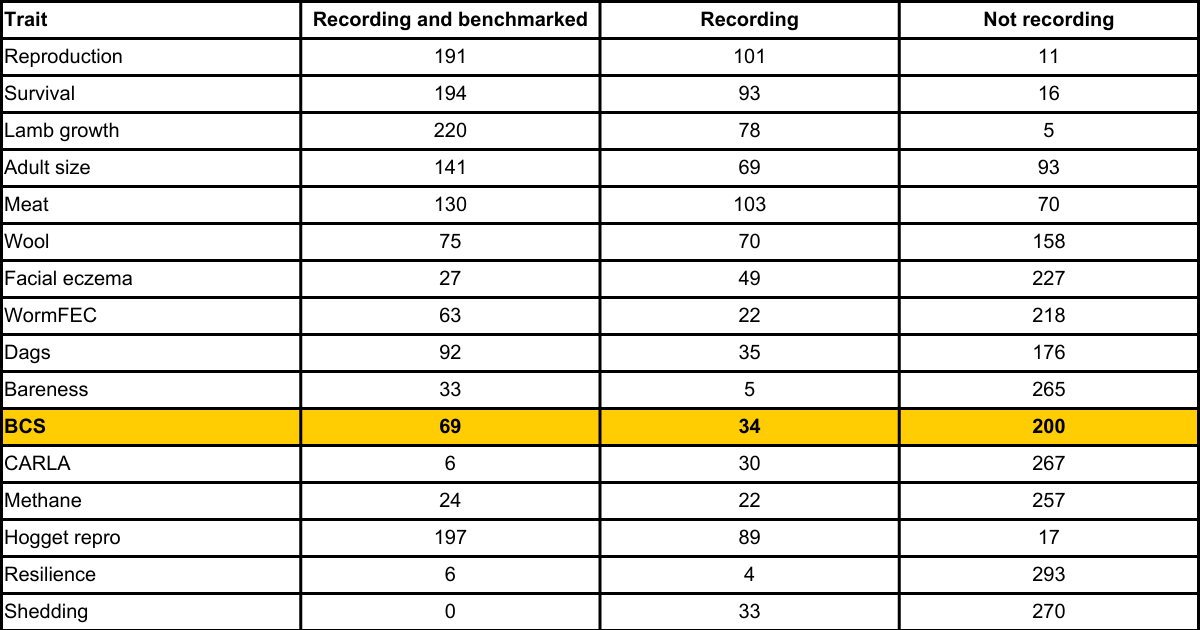
As you can see, out of those 303 maternal flocks, 69 were actively recording and benchmarking BCS, and a further 34 flocks had at least recorded the trait. But there were 200 flocks not recording BCS. Beyond the labour involved, this is a trait that is free to assess and record, with no lab testing or fancy equipment required. And it is a trait that has such a widespread effect on so many other aspects of production.
Take a moment to look at those BCS stats against the other traits in Table 1. For those maternal flocks, there are 210 weighing their adult ewes at least once a year (i.e. adult size), but only 103 that are recording a condition score. And there are 145 maternal flocks still recording a fleece weight! While we all remain hopeful that wool is going to make a comeback, if I were to choose one of these two traits to record in the strong-wool (or ever increasing no-wool) breeds, it will always be BCS above fleece weight.
On a positive note, there are 127 flocks recording dags (another free to measure score), which is certainly a trait of interest to a lot of commercial farmers, and has implications for on-farm costs. Interestingly, there are 85 flocks recording WormFEC, a process that puts pressure on growing stock and comes with a decent price tag per individual tested.
Don’t get me wrong, I am supportive of the people dedicating the time, resources, and funds to recording the traits that commercial farmers are looking for when choosing which driveway to head up for their ram selections. We need more breeders like you.
My point is that there is an opportunity here to give your ram-buying clients more value with little extra effort. If you are not yet recording an individual BCS record for each of your ewes once a year, have a think about the future implications of not doing this. This trait takes nothing more than time to record and can usually be incorporated into another job.
When to record body condition score in stud ewes
There are a few different BCS records that can be entered into SIL, including BCS at mating (within a month, either before or after the breeding period), at pregnancy scanning, pre-lambing, at docking/tailing, or at weaning. So, there are plenty of opportunities to get a record.
The preference is for the breeding/pregnancy scanning record if only one is being recorded, as this usually captures the most animals (before dries are removed) and is relatively unaffected by pregnancy/lactation. Nearly all flocks are recording reproduction in some way (usually a pregnancy scan), so why not record the body condition score at the same time? Another easy win is recording BCS at the same time as recording ewe live weights.
The importance of condition score for ram buyers
Commercial farmers, have the chat with your ram breeder and make sure that they are recording traits that are important to you. This applies to all traits of interest, but start with the ones that are free to record. Stud breeders are service providers and are usually in the industry because they enjoy performance recording and producing a product that meets the needs of their customers.
I certainly understand for some breeders that there are already a lot of costs associated with the recording that goes into stud breeding. Things like meat (eye muscle scanning), WormFEC or CARLA, and facial eczema (FE) testing, all come with a price tag attached. Even reproduction can have a higher price tag, especially if you are getting exact litter size (not just dry, single, multiple) or foetal aging for lamb date of birth.
Ram breeders need to toss up the traits that they want or need to put the money into recording, to get the best combination for their customers. However, other than the time it takes to record the score, BCS recording is absolutely free, and there should be no excuses not to do it. If you are unsure of how to accurately record the score, check out our free guide below. Or you can give one of our consultants a call to help set you up for success.
Heritability, correlations and free lunches
Body condition score has a 25% heritability, making it moderate-highly heritable. This means that selection based on the BCS breeding value can make quick progress in your flock. Aside from body condition itself, the genetic correlations with other traits offer other benefits to productivity. These are essentially a free lunch!
Positive genetic correlations exist between BCS and liveweight (LWT) at the time of measurement, other BCS measures throughout the year, fat depth, eye muscle depth, fibre diameter, conception rate, ovulation rate, maternal behaviour scores, lamb survival at birth and to weaning, weight of lambs weaned and more (Everett Hincks & Cullen 2009; Shackell et al 2011; Tait et al 2018).
While some of these correlations are quite high (e.g. BCS and LWT at the same time), and others are decidedly lower (e.g. BCS and lamb weaning weight), they are still positive, giving at least a small snack in that free lunch. For a great review on the effects of BCS on production traits see the scientific review by Kenyon et al (2014) (link provided below).
What about body condition score in terminals?
For the terminal flocks, reporting BCS is a lower priority. But again, this is a free trait to record and can be used to help monitor and manage your ewe flock at the individual level. Why not add this to your list of traits to record?
Selecting rams that have positive breeding values for BCS can help to indirectly increase other production metrics in the progeny that they produce. There are benefits in carcass and fat yield traits, as well as lamb survival traits; all of these traits have genetic correlations with BCS and can be of benefit to the terminal lamb.
Make the most of the genetic tools available
As always, have a plan about the relative priority of each breeding value of importance to your flock, and look at where the cut-offs could or should be for each trait. SIL and Sheep Genetics both have percentile bands table resources, which indicate where a particular breeding value or index value sits in relation to other flocks connected for that trait.
For New Zealand breeders, the nProve website allows you to use the sliders to navigate realistic breeding value targets for a range of traits all at the same time. In Australia, the Sheep Genetics website allows you to search using cut offs for particular traits (with the percentile tables displayed for reference), adding multiple traits into the search. Both websites indicate the breeders that match your criteria the best, allowing you to make informed decisions about who to buy rams from.
Remember, the ewes in your stud flock are producing rams for sale, and those rams are producing replacements for commercial farmers. With condition score being one of the biggest determinants of ewe production, reporting this trait should be essential for all breeders and buyers alike. If you are already recording, great job, please keep it up! For the stud breeders out there not yet recording BCS on their ewes, ask yourself, ‘Why not?’ Perhaps 2026 is your year to start.
---
Monitoring the BCS of your flock, and adjusting feed to prioritise those that need it, will help you achieve optimum production and profit. All it takes is a quick hand over your ewes whenever they are in the yards. For more about the importance of assessing BCS, check out the link to Ferg’s recent article here.
---
References
Everett-Hincks, J.M. & Cullen, N.G. (2009). Genetic parameters for ewe rearing performance. Journal of Animal Science 87, 2753-2758. https://pubmed.ncbi.nlm.nih.gov/19502504/
Kenyon, P.R., Maloney, S.K. & Blache, D. (2014). REVIEW ARTICLE: Review of sheep body condition score in relation to production characteristics. New Zealand Journal of Agricultural Research 57(1), 38-64. https://www.tandfonline.com/doi/epdf/10.1080/00288233.2013.857698?needAccess=true
Shackell, G.H., Cullen, N.G. & Greer, G.J. (2011). Genetic parameters associated with adult ewe liveweight and body condition. Proceedings of the Association for the Advancement of Animal Breeding and Genetics 19, 103-106. https://aaabg.org/livestocklibrary/2011/shackell103.pdf
Tait, I.M., Kenyon, P.R., Garrick, D.J., Pleasants, A.B. & Hickson, R.E. (2018). Genetic and phenotypic correlations between production traits and adult body condition scores in New Zealand Merino ewes. New Zealand Journal of Animal Science and Production 78, 71-75. https://www.nzsap.org/system/files/proceedings/genetic-and-phenotypic-correlations-between-production-traits-and-adult-body-condition-scores-new.pdf

.webp)